
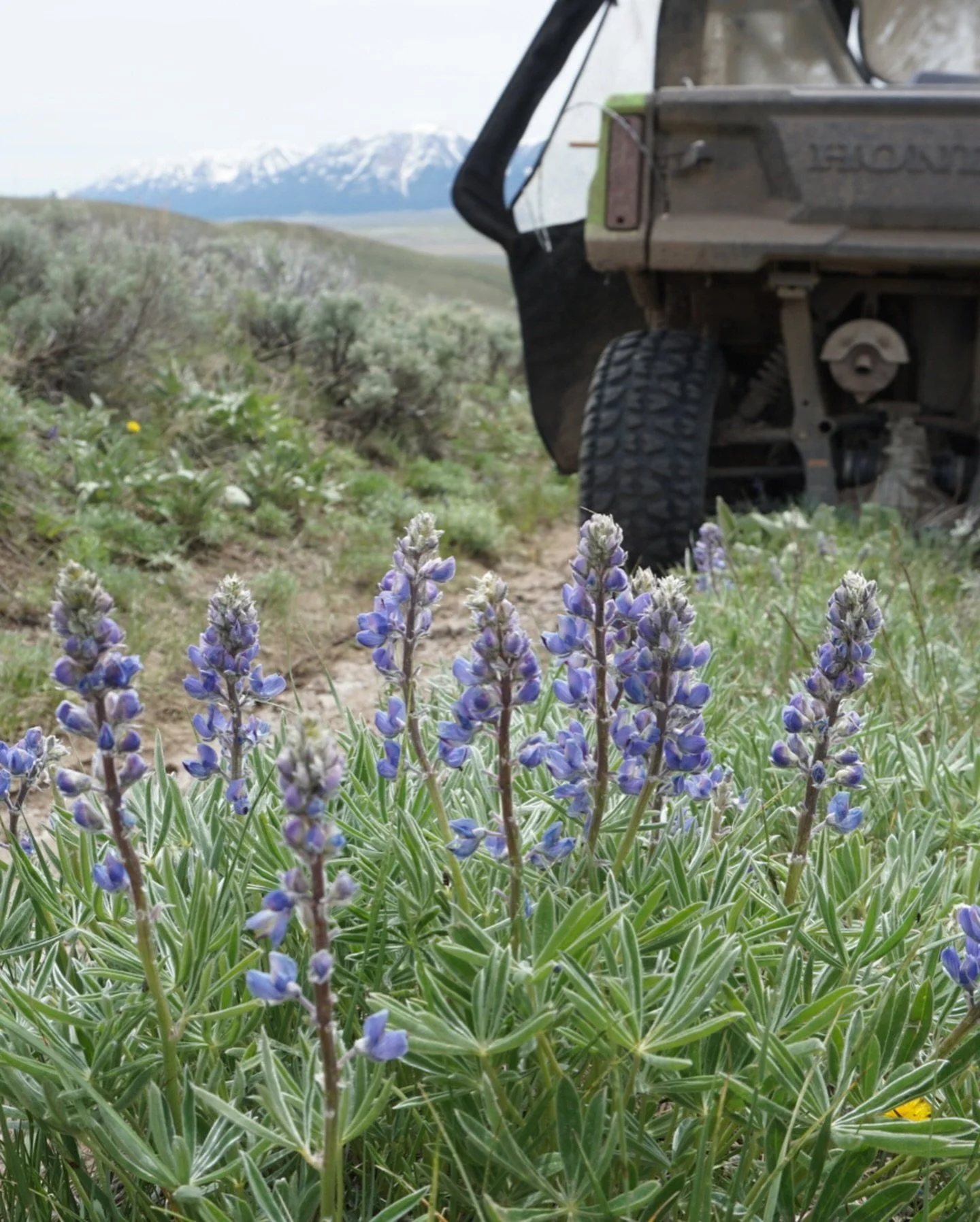
Lupinus argenteus, Silvery Lupine
Artist: Sarah Red-Laird
Title: Bee Habitat in Cyanotype 28
Location: J-L Ranch, Montana, Lupine Hill Study Area
Project: Buzz on the Range
Flower: Lupinus argenteus, Silvery Lupine
Bee: Bombus, Bumble bee
Materials: Cyanotype
Field Season: 2023
Composed: 2025
The Artist
Sarah Red-Laird is a melittologist, artist, conservationist, and founder and co-director of the nonprofit organization, Bee Regenerative.
She spends the colder months living near her Southern Oregon art studio and “field season” in Montana and South Dakota in her campervan/bee lab studying bees, bison, cattle, and the plants and soil that connect them.
She works with cyanotype to create images of the flowers and charismatic mega and mini-fauna she studies.
Sarah lives her life outside of the bounds of convention to be close to the natural world where the sky is big, the water talks, the air hums, and the ground rumbles with buffalo bellows. Through her art, she hopes to bring you closer to this world, as well.
The Piece
The flower in this print is Lupinus argenteus, silvery lupine. Tall, conical spikes of small blue-purple flowers, stacked one on top of the other like a pagoda. The leaves are palmate — each one a half-open hand of slender leaflets radiating from a central point. The whole plant is covered in fine silvery hairs that catch and hold the light, which is where it gets the second half of its name. On a summer morning the hairs are wet with dew, and a hillside of silvery lupine looks, from a distance, like the hillside itself is glowing.
Like all the lupines, this one is a legume. The roots host bacterial colonies that pull nitrogen out of the air and fix it into a form the plant can use, which is also a form everything growing around it can eventually use. A meadow seeded with lupine, season after season, is a meadow getting slowly richer. That is part of why a single hillside of silvery lupine ends up surrounded by the diversity of other forbs and grasses you find at this site.
I pressed this flower in 2023, on a south-facing hill at the J Bar L Ranch in the Centennial Valley of Montana — a hill so densely covered in this one plant that we named the study area on it Lupine Hill. The print took two more years to come together. Sometimes the flower presses fine and the image arrives a season later; sometimes the image waits in the studio for years while I figure out what it is trying to say.
What this one is trying to say, I think, is that some flowers are built for some bees and some bees for some flowers, and that to journey into a hillside where both are present in the right numbers is to walk into a piece of working evidence that the ranching surrounding it is doing something quietly right.
The Bees
The bee on this print is a bumble bee — a member of the genus Bombus, the soft-bodied, oversized, cold-tolerant bees that dominate the pollinator fauna of high-elevation montane meadows like the one this flower came from. Bumble bees thermoregulate; they vibrate their flight muscles to warm up before takeoff, which lets them fly at temperatures that ground every other social bee. On a frosty Montana morning, the bumble bee is the only one out.
Silvery lupine is one of the plants that needs her.
Like other lupines, Lupinus argenteus has a closed keel — the lower pair of petals fuse into a curved enclosure that hides the pollen-bearing anthers inside. The keel is sprung. To release the pollen, a visiting bee has to push down on the flower with enough weight and force to open the keel, exposing the pollen and the stigma at the same instant. Honey bees can manage some legume flowers, but they are mostly too light to work a lupine consistently. Bumble bees, with their larger bodies, do exactly the job the flower is built for — and many of them go a step further by buzz-pollinating, gripping the flower and vibrating their flight muscles at high frequency to shake the pollen loose. The lupine and the bumble bee are, in a real mechanical sense, designed for each other.
Two field seasons of monitoring at J Bar L have made the strength of that relationship visible in the data. Silvery lupine is one of the most-recorded plants on our vegetation transects across the ranch — 73 records, in the “Very High” pollinator-value tier, and explicitly flagged in our report as a bumble bee favorite. The bee community it supports is correspondingly rich. We have documented eight bumble bee species at J Bar L, three of them listed as Vulnerable on the IUCN Red List — Bombus fervidus, Bombus californicus, and Bombus occidentalis, the western bumble bee currently under consideration for federal endangered-species protection. The most-recorded bumble bee on the ranch is Bombus huntii, Hunt’s bumble bee, and the bumble bee on this print is very likely her.
If you ever find yourself walking through a hillside of silvery lupine in late June, stop for a minute and watch the keel petals dip and spring back as the bumble bounces from flower to flower.
The Process
The “cyanotype” process was developed by British astronomer and chemist Sir John Herschel in 1842. It’s a photographic process that uses iron salts to create a deep blue image. Initially developed for reproduction of his own scientific notes and drawings, it was popularized by his friend, Anna Atkins, a botanist who published a book illustrated with photographs using the cyanotype process, Photographs of British Algae: Cyanotype Impressions.
My attraction to cyanotype printing may be related to my affinity for the scientific method. Though the subject of each piece is steeped in story and complexity, the image itself cannot be manipulated by perception. It simply is a print of simple reality.
This is the hook. As humans, we crave simplicity.
But agriculture is not simple, it’s complicated, complex, and contextual.
The striking cyan-blue entices the viewer to the piece and then invites a deeper inquiry.
I hope each viewer makes the journey to my website to learn about Bee Regenerative’s work with bees on agricultural landscapes and also where to connect with me as I travel around the country speaking on the beautifully complicated connections between bees, bison, cattle, ourselves and everything in-between.
The Work
Beginning in 2023, Bee Regenerative began a multi-year collaboration with the Anderson family of Montana and the three ranches they collectively manage — J Bar L in the Centennial Valley, and the Anderson Ranch and Grizzly Creek in Tom Miner Basin. The question we’re trying to answer is whether ranching built around coexistence with native predators — wolves, grizzly bears, beavers — can also be ranching that supports robust, diverse native bee communities.
The question started for me in 2018, at a workshop called “Range Riders: Coexisting with Predators” at the EcoFarm conference. I had spent a year as a student in the University of Montana’s Wilderness and Civilization program a decade earlier, and I knew the long, painful arc of the conversation around wolf reintroduction in the Northern Rockies. What I didn’t expect was to spend that workshop sitting in the back row listening to Hilary Zaranek talk about what happens to a landscape when ranchers stop trying to kill the predators and start learning to live among them. Beavers come back. Riparian zones recover. Aspen come up where the elk used to mow them flat. The whole trophic system slowly knits itself together again.
Walking out of that workshop, I had one stubborn question: do the bees come back, too?
Three field seasons in, the answer is increasingly yes. Across the three Anderson-family ranches we have now documented 118 native bee species — and thirteen species of bumble bees, four of them species of conservation concern. We have confirmed twenty-seven specialist bees that can only complete their life cycles in the presence of specific native plant communities. We have spotted Bombus occidentalis, the western bumble bee — declining catastrophically across most of its former range — in a high mountain pasture that the Anderson family deliberately co-grazes with grizzly bears.
Hannibal Anderson, one of the family’s third-generation ranchers, said it well in an interview with NPR a few years back: “I don’t see the world as a place where humans just get to trump everything else. I consider it a really fundamental responsibility of being human to serve the ecological integrity of wherever we live.” What we are documenting at J Bar L, the Anderson Ranch, and Grizzly Creek is what that sentence looks like at the level of a bee community.
Your support of this card supports that work. Three field seasons in, the data is starting to answer a question that has not yet been asked at this scale anywhere else: could coexistence ranching be one of the keys to native bee conservation on western working lands?