

Artist: Sarah Red-Laird
Title: Bee Habitat in Cyanotype 80
Location: Dakota Partnership Bison Ranch, South Dakota
Project: Bison & Bee Habitat
Flower: Medicago falcata, Sickle Alfalfa
Bee in cyanotype: Apis mellifera, Honey bee
Materials: Cyanotype print
Field Season: 2023
Composed: 2025
The Artist
Sarah Red-Laird is a melittologist, artist, conservationist, and founder and co-director of the nonprofit organization, Bee Regenerative.
She spends the colder months living near her Southern Oregon art studio and “field season” in Montana and South Dakota in her campervan/bee lab studying bees, bison, cattle, and the plants and soil that connect them.
She works with cyanotype to create images of the flowers and charismatic mega and mini-fauna she studies.
Sarah lives her life outside of the bounds of convention to be close to the natural world where the sky is big, the water talks, the air hums, and the ground rumbles with buffalo bellows. Through her art, she hopes to bring you closer to this world, as well.
The Piece
The flower in this print is a yellow one, and that surprises most people. When we picture alfalfa, we picture the purple-flowered haymaker — Medicago sativa — running in long irrigated rows across the valleys of the American West. But the Medicago genus is wider than that. This is Medicago falcata, sickle alfalfa: a yellow-flowered cousin, native to Eurasia, brought to the Northern Plains by earlier waves of ranchers looking for a hardier, more drought-tolerant cool-season forage. It takes its name from the curled, sickle-shaped seedpods it produces in late summer.
I pressed this flower in the summer of 2023, at the Dakota Partnership Ranch near the southern Black Hills of South Dakota — a 27,000-acre working bison ranch. Specifically, I pressed it inside the boundary of a place we call the “Control” plot. This study area is an eleven-hectare plot fenced off in late 2022 to keep the bison out, while every other piece of the climate, soil, and weather around it stays the same. It is the reference frame against which our team measures everything else we do on this land.
2023 was a wet, cool-season year. Alfalfa and sweet clover were everywhere on the property, and the bees came in behind the bloom in numbers we hadn’t seen before or since. Control held its own version of that pulse: yellow heads of sickle alfalfa scattered through the grass, the first warm flowers honey bees and native bees alike could find on a clear morning. The print you’re holding came from a flower picked in that bloom.
Two years on, Control has changed.
The 2024 growing season was the second-warmest and eighteenth-driest on record for the Black Hills region, with 100+ mph wind events and extreme summer hailstorms that flattened the cool-season legume base across the whole ranch. Inside Control, with no bison to graze the grasses or break up the soil with wallows, dead grass thatch piled up in lodged layers and smothered the native forbs trying to come up underneath. By 2025, the alfalfa stems we had counted at twenty-one in 2023 had retreated to one.
What the “Control” study area teaches us, by what it loses, is that the floral abundance the bee community depends on was never a free gift of the prairie. It was being made — actively, continuously — by the herd. The grass-grazing, the wallowing, the bison’s peculiar habit of leaving the native forbs alone and eating the grasses and non-native legumes instead — all of that is engineering, in the most patient and gentle sense of the word. When we take the herd off the land, the engineering stops. The thatch closes in.
This print is a record of a yellow flower that bloomed in a window that has not yet returned.
The Bees
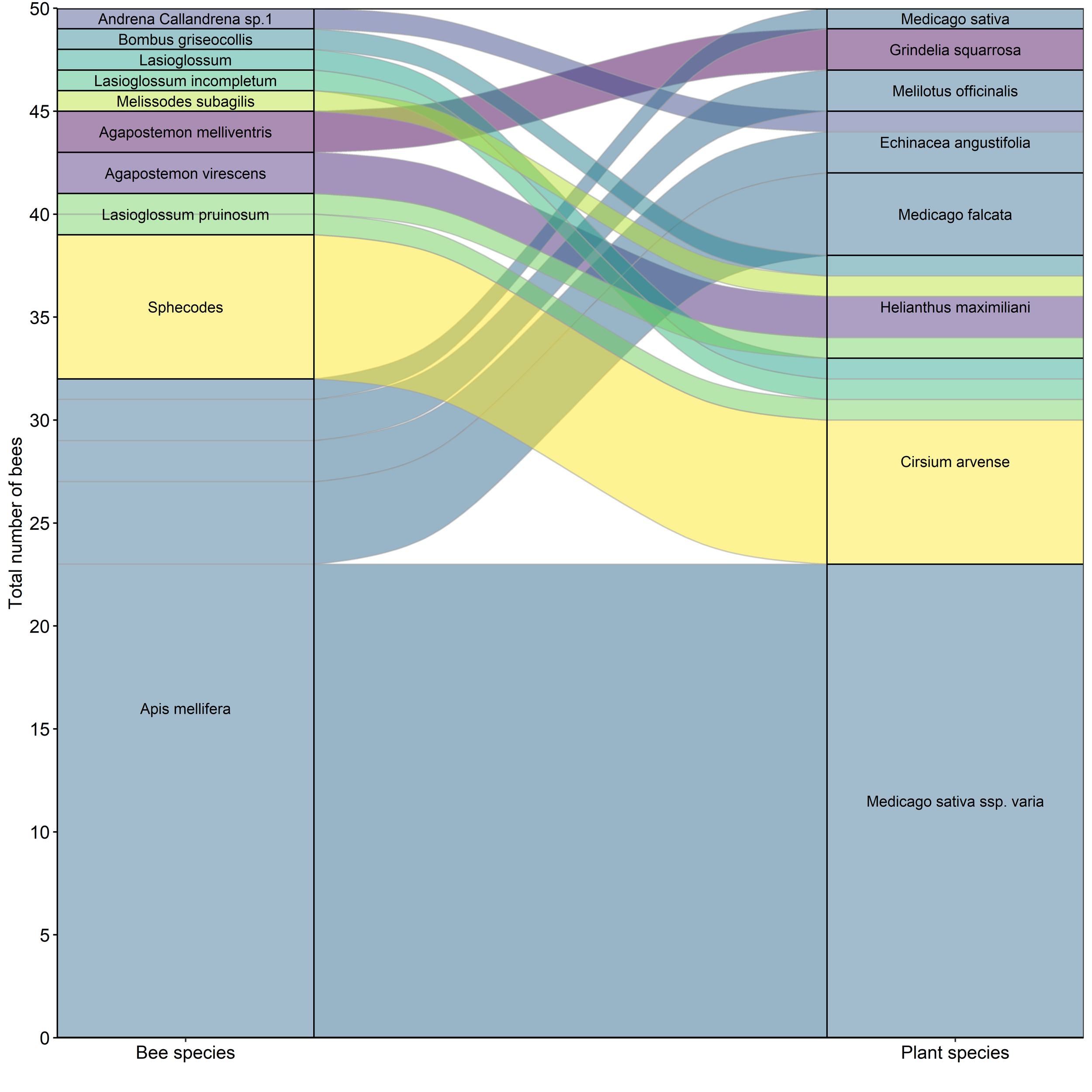
The honey bee on this print is Apis mellifera, a forager from one of the commercial colonies hosted at the ranch by a commercial beekeeper. In 2024, he kept approximately 1,225 hives across seventeen apiaries on this property — one of the largest single-site honey bee deployments in the region. The bee photographed here was working a flower in 2023, when the cool-season legume bloom was carrying both his colonies and the wild bee community on the same landscape, in different floral lanes — his colonies on the legumes, the native bees on the warm-season forbs and composites.
That separation is what we have come to call coexistence, and it is the central question driving our honey bee research on the property: when can managed apiaries and native bee communities share a working landscape without competing, and when can they not? The answer, increasingly, looks like a function of how much is in bloom.
In late August of 2024 — after the cool-season legume base had collapsed and both communities were being forced onto the same narrow list of late-summer composites — we pulled twelve bee samples from six of the apiaries for virus and body-condition screening. The results were sobering. Every hive carried at least one of eight viruses on the panel. Israeli Acute Paralysis Virus was elevated above reference averages in more than half of them. Eleven of the twelve hives had workers below the published optimal weight range for healthy honey bees. Sub-clinical Nosema — a stress indicator, not yet a treatment-threshold infection — showed up in a third of the samples. By the following spring, the beekeeper had lost seventy-five percent of his entire operation overwinter.
He made the structural decision to move the bulk of his hives east, into eastern South Dakota, Iowa, and Minnesota, citing post-2024 dryness in western South Dakota as the reason. His 2025 deployment at the bison ranch came in at 120 hives — a ninety-percent pullback at this single property.
The honey bee on this print, then, is a forager from a deployment that no longer exists at the same scale. The print preserves a moment of abundance, in the same way that the sickle alfalfa beside it does — a moment in which there was enough on the landscape for two bee communities to share it without crowding.
The Process
The “cyanotype” process was developed by British astronomer and chemist Sir John Herschel in 1842. It’s a photographic process that uses iron salts to create a deep blue image. Initially developed for reproduction of his own scientific notes and drawings, it was popularized by his friend, Anna Atkins, a botanist who published a book illustrated with photographs using the cyanotype process, Photographs of British Algae: Cyanotype Impressions.
My attraction to cyanotype printing may be related to my affinity for the scientific method. Though the subject of each piece is steeped in story and complexity, the image itself cannot be manipulated by perception. It simply is a print of simple reality.
This is the hook. As humans, we crave simplicity.
But agriculture is not simple, it’s complicated, complex, and contextual.
The striking cyan-blue entices the viewer to the piece and then invites a deeper inquiry.
I hope each viewer makes the journey to my website to learn about Bee Regenerative’s work with bees on agricultural landscapes and also where to connect with me as I travel around the country speaking on the beautifully complicated connections between bees, bison, cattle, ourselves and everything in-between.
The Work
The modern agricultural practice of monoculture creates habitat loss, drives climate change, and requires overuse of pesticides. This unsustainable practice is connected to staggering losses of honey bee colonies and native bee populations. Creation and conservation of refugia for bees on ranchlands is one solution for their survival. Holistically managed bison herds are currently being utilized to mimic the historical ecological impact these animals had on the pre-colonial Great Plains. We theorize the trophic rewilding of the landscape on bison ranches in South Dakota and Montana has restored nutrient dense habitat and created ample nesting sites for bees. To understand the potentially synergistic or mutualistic interactions between honey bees, native bees, and bison we are monitoring vegetation, soil, grazing behaviors, and pollinator communities on western plains and prairies. These efforts will examine bee nesting frequency, bee habitat, bee communities, soil health, and flower pollen availability and nutritional content. Our goal is to utilize the findings from our research projects to positively influence future conservation, policy, and land management decisions for both bees and bison through education, relationship building, art, and advocacy.