
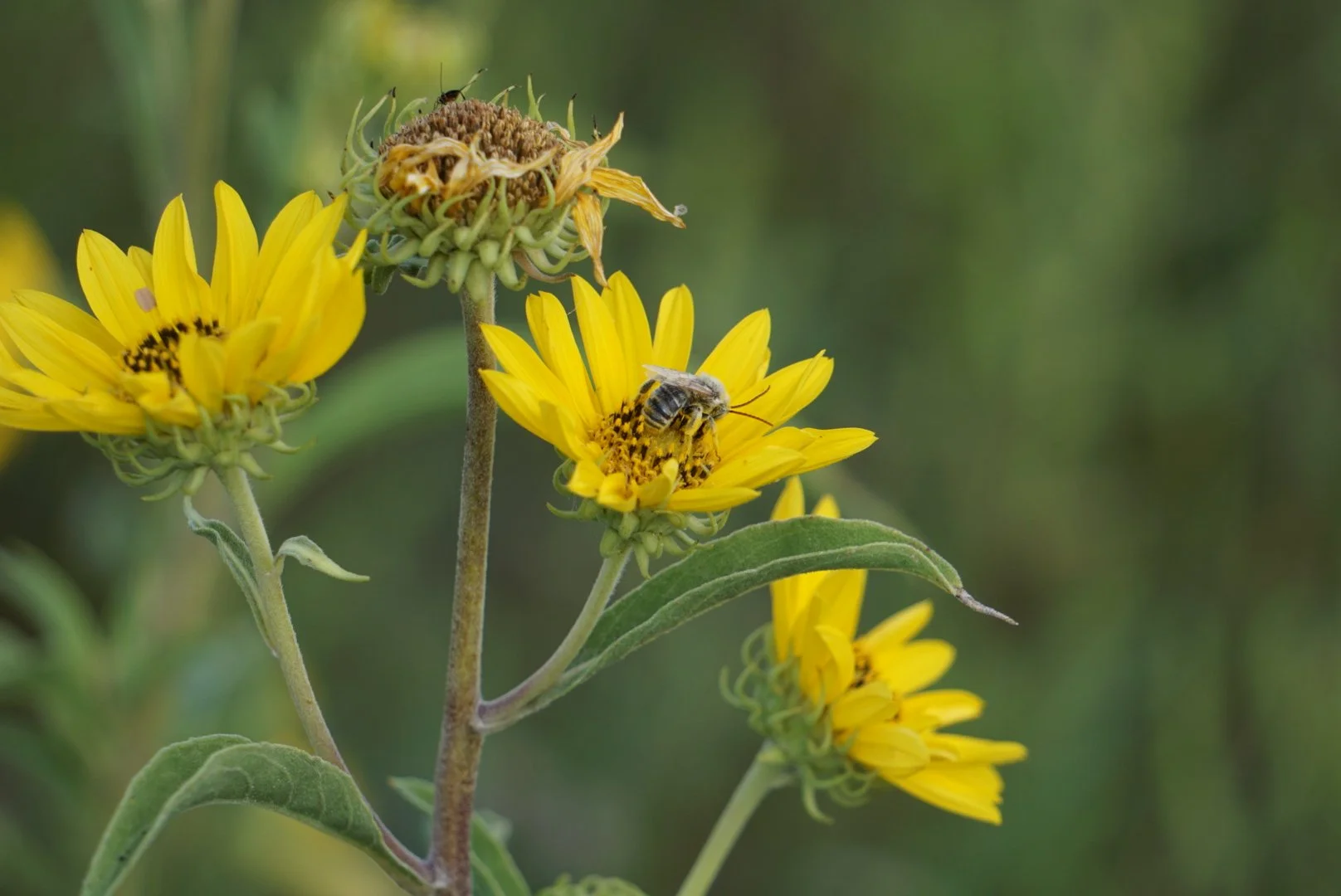
Helianthus maximiliani, Maximilian sunflower
Melissodes agilis, the agile long-horned bee
Artist: Sarah Red-Laird
Title: Bee Habitat in Cyanotype 89
Location: Dakota Partnership Ranch, South Dakota
Project: Bison & Bee Habitat
Photo subject: Melissodes agilis, the agile long-horned bee on a Helianthus maximiliani, Maximilian sunflower
Materials: Cyanotype, Barnwood
Field Season: 2024/25
Composed: 2025
The Artist
Sarah Red-Laird is a melittologist, artist, conservationist, and founder and co-director of the nonprofit organization, Bee Regenerative.
She spends the colder months living near her Southern Oregon art studio and “field season” in Montana and South Dakota in her campervan/bee lab studying bees, bison, cattle, and the plants and soil that connect them.
She works with cyanotype to create images of the flowers and charismatic mega and mini-fauna she studies.
Sarah lives her life outside of the bounds of convention to be close to the natural world where the sky is big, the water talks, the air hums, and the ground rumbles with buffalo bellows. Through her art, she hopes to bring you closer to this world, as well.
The Piece
The first flower that caught my eye when I arrived at the ranch in 2022 was a Maximilian sunflower. I was out on a wild, six-hour tour of the property with ranch manager Moritz, and Helianthus maximiliani stopped me in my tracks — striking, abundant, and utterly alive with purpose.
I've been falling deeper in love with this flower ever since.
Maximilian sunflowers are rhizomatous, meaning what looks like a field of individual plants is often one vast, interconnected organism — more like an aspen grove than a wildflower patch. They are fire-resilient (a farmer who planted a field of them after learning about my test plots in Ashland, Oregon wrote to tell me their field was nearly the only thing left standing after the Almeda fire). And in late summer, when they bloom, they are without question the most important flowers on this ranch — feeding more bee species, in greater numbers, than anything else out here.
But the detail that has captivated me most is what the bison do with them.
Watching the herd move through the study plot we call Skull Shed, I noticed that the bison never touched a blooming sunflower. Not one leaf, not one petal. They would wait — sometimes just a day or two after a flower had finished blooming and gone to seed — and only then would they pass through and munch the tops. In the meantime, they were busy mowing down the smooth brome, a non-native grass so aggressive it crowds out the native forbs and bunchgrasses that bees depend on. The bison chewed the brome to nubbins and left every sunflower standing.
They were, quite literally, gardening for the bees.
And there's more: as the herd moves through the spent flower stalks, the spiky dried heads act like velcro, pulling tufts of their thick winter coat free. On a still morning you can see it — a sea of flower skeletons draped in impossibly soft, downy bison fur, waving gently in the wind. Birds and prairie dogs come through and peel it off, stitch by stitch, to line their spring nests.
Every layer of this ecosystem holds another gift.
The Bees
Also featured in this piece is an agile long-horned bee, Melissodes agilis, specimen number 24RS4-7 from the Bee Regenerative research collection. This female was collected on September 1, 2024, from a Maximilian sunflower in our study plot at a ranch in Custer County, South Dakota — the very same flower, and the very same ranch, depicted in this piece.
Melissodes agilis is a solitary, ground-nesting bee with a particular affinity for the Asteraceae — the sunflower family. Females nest in underground burrows, where they provision individual brood cells with pollen. Males, meanwhile, are known to sleep communally on sunflower heads at night, tucking themselves into the junction between the ray and disc florets, sometimes a dozen at a time.
The species is active through summer and into early fall, with populations tracking closely behind the bloom of their preferred flowers. On a good August or September day at the ranch, a single patch of blooming Maximilian sunflowers can be alive with them.
We are working with our ranching partners to better understand the communities of bees like Melissodes agilis on this land — and to explore the remarkable ways bison may be engineering the very habitat these bees depend on.
Sources:
The Process
The “cyanotype” process was developed by British astronomer and chemist Sir John Herschel in 1842. It’s a photographic process that uses iron salts to create a deep blue image. Initially developed for reproduction of his own scientific notes and drawings, it was popularized by his friend, Anna Atkins, a botanist who published a book illustrated with photographs using the cyanotype process, Photographs of British Algae: Cyanotype Impressions.
My attraction to cyanotype printing may be related to my affinity for the scientific method. Though the subject of each piece is steeped in story and complexity, the image itself cannot be manipulated by perception. It simply is a print of simple reality.
This is the hook. As humans, we crave simplicity.
But agriculture is not simple, it’s complicated, complex, and contextual.
The striking cyan-blue entices the viewer to the piece and then invites a deeper inquiry.
I hope each viewer makes the journey to my website to learn about Bee Regenerative’s work with bees on agricultural landscapes and also where to connect with me as I travel around the country speaking on the beautifully complicated connections between bees, bison, cattle, ourselves and everything in-between.
The Work
The modern agricultural practice of monoculture creates habitat loss, drives climate change, and requires overuse of pesticides. This unsustainable practice is connected to staggering losses of honey bee colonies and native bee populations. Creation and conservation of refugia for bees on ranchlands is one solution for their survival. Holistically managed bison herds are currently being utilized to mimic the historical ecological impact these animals had on the pre-colonial Great Plains. We theorize the trophic rewilding of the landscape on bison ranches in South Dakota and Montana has restored nutrient dense habitat and created ample nesting sites for bees. To understand the potentially synergistic or mutualistic interactions between honey bees, native bees, and bison we are monitoring vegetation, soil, grazing behaviors, and pollinator communities on western plains and prairies. These efforts will examine bee nesting frequency, bee habitat, bee communities, soil health, and flower pollen availability and nutritional content. Our goal is to utilize the findings from our research projects to positively influence future conservation, policy, and land management decisions for both bees and bison through education, relationship building, art, and advocacy.